


The Business Case for Occupational Health
Protect your workforce. Reduce costs. Ensure compliance.
Occupational health services protect workers’ health, reduce sickness absence costs, and help employers compley with the law.
Our servicvess add value through improved productivity, faster return to work and lower business costs.
1. Reducing Sickness Costs
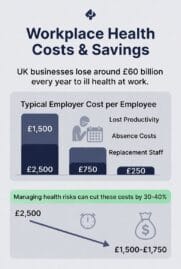
UK businesses face total costs of £22.9 billion each year from workplace injuries and ill health (HSE, 2024/25 statistics, based on 2023/24 costs).
Ill health accounts for £16.4 billion of this.
This works out at approximately £2,500 per employee in lost productivity, absence and replacement staff.
The Scottish Government calculator shows that even a small business with 10 workers loses £13,600 annually to mental health absence alone.
Occupational health input can reduce these costs by 30–50%.
Early referral shortens long-term absence from an average of 15 weeks to 4–5 weeks.
Studies show faster returns and lower costs when there is early contact and agreed workplace changes. One large employer reduced absence from 5.5 % to 3 %, saving £1.2 million a year through team-based occupational health support (Society of Occupational Medicine: Occupational Health: The Value Proposition Dr Paul Nicholson OBE, March 2022)
2. Managing Absence
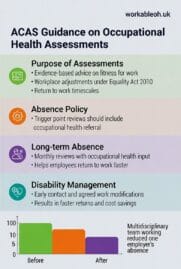
According to ACAS occupational health assessments are useful when an employee’s health affects their work.
Equally importantly, OH assessment can support employees when work affects their health. Health surveillance can detect early signs of conditions such as occupational asthma or noise-induced hearing loss before permanent damage occurs.
Absence policies should include occupational health referral at trigger points. Monthly reviews during long-term absence, with occupational health advice, help people return to work sooner.
3. Preventing Work-Related Illness
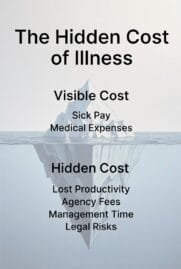
Work-related illness costs £16.4 billion annually.
There are approximately 34 million people in employment in the UK (ONS, 2025).
In 2024/25, 1.9 million workers (6% of workforce) in Great Britain had work-related ill health.
The average number of working days lost to all sickness or injury was 4.4 days per worker in 2024 (ONS 2024).
For work-related ill health specifically, the average time taken off work was 16.4 days per affected person: – 23 days for stress/depression/anxiety and
– 14.0 days for musculoskeletal disorders (HSE, 2024/25).
This included 964,000 cases of stress, depression or anxiety and 511,000 cases of musculoskeletal disorders (HSE, 2024/25).
4. Improving productivity and retention
Healthy, supported employees are more productive and loyal. Companies that embed health in their values see higher engagement and lower turnover.
Early OH intervention returns 75% of treated staff to work quickly. One major study showed £1 spent on OH avoids £1.66 in absence costs. Organisations with dedicated OH nurses achieve the strongest ROI through sustained lower absence. (Society of Occupational Medicine, 2022).
Early OH intervention returns 75% of treated staff to work quickly. One major study showed £1 spent on OH avoids £1.66 in absence costs. Organisations with dedicated OH nurses achieve the strongest ROI through sustained lower absence.
Employees feel valued when employers provide health support, improving morale and retention. Workers are more likely to choose employers who take health seriously.
5. Meeting Legal Duties
The Health and Safety at Work Act 1974 requires employers to prevent work-related ill health. The Management of Health and Safety at Work Regulations 1999 require appointment of competent persons to manage health risks.
Health surveillance is required under COSHH, noise and vibration regulations when risk assessments identify ongoing risks. Appointed doctors must examine workers exposed to asbestos, lead, ionising radiation or compressed air.
The Health and Safety Executive continues to focus enforcement on respiratory disease and cancer. Regular surveillance shows that risks are being managed properly.
Directors can be held personally liable for serious breaches. Fines often exceed £1 million and the Health and Safety Executive publishes all convictions.
Useful References
Health and Safety Executive: Occupational Health
Society of Occupational Medicine: The Value Proposition by Dr Paul Nicholson OBE (2022)
Last Update February 2026 by Workable OH